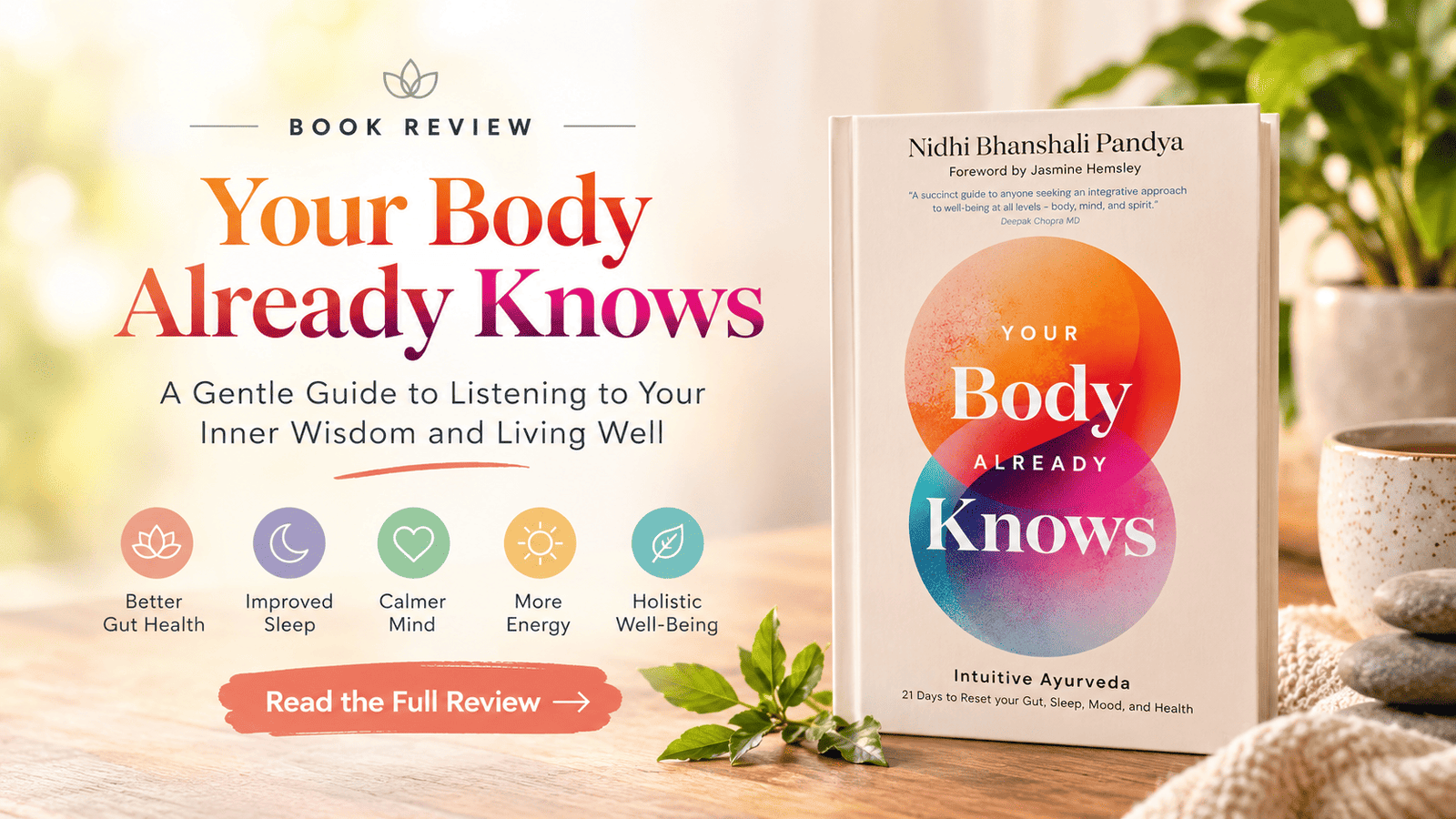

If you’ve spent any time scrolling wellness content in 2025–2026, you’ve probably seen Your Body Already Knows: Intuitive Ayurveda — 21 Days to Reset Your Gut, Sleep, Mood, and Health pop up on your feed. Written by Ayurvedic practitioner Nidhi Bhanshali Pandya and published by Watkins Publishing in March 2025, the book has quickly become one of the more talked-about entries in the modern Ayurveda space — currently sitting at a strong 4.3+ average rating across hundreds of reader reviews.
I read it cover to cover to figure out whether it lives up to the buzz, who it’s actually useful for, and whether it’s worth adding to your shelf. Here’s the honest breakdown.
Bibliographic Information
- Title: Your Body Already Knows: Intuitive Ayurveda – 21 Days to Reset Your Gut, Sleep, Mood, and Health
- Author: Nidhi Bhanshali Pandya
- Publisher: Watkins Publishing (UK)
- Publication Date: 11 March 2025
- Pages: 320
- Formats: Hardcover; also Kindle eBook and audiobook (Audible) available.
- ISBN: 1786789280 (ISBN-13: 9781786789280)
- Price: List price ~$20.95 (Hardcover) (used from $13.79 on ThriftBooks).
- Foreword: Jasmine Hemsley (wellness author).
- Languages: English; the book is already translated into 9 languages.
- Availability: Widely available online (Amazon, Indigo, etc.).
Who Wrote It — And Why That Matters
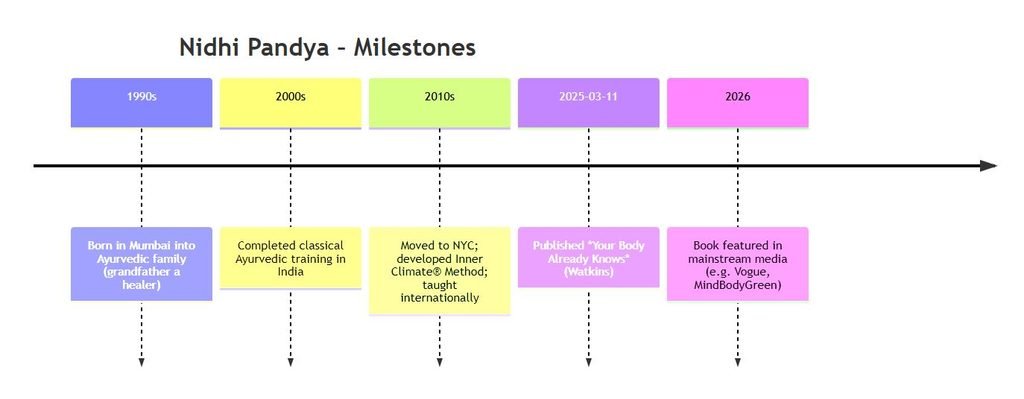
Nidhi Pandya isn’t a wellness influencer who picked up Ayurveda as a side interest. She trained formally for several years at a traditional Gurukulam-style institution, and she’s the granddaughter of a well-regarded Ayurvedic healer from India. That lineage shows up throughout the book — this isn’t a westernized, diluted version of Ayurveda repackaged for Instagram. It’s someone translating a real clinical and family tradition into a format a total beginner can actually follow.
Notably, the book carries a cover endorsement from Deepak Chopra, MD, who called it a guide for anyone seeking an integrative approach to wellbeing across body, mind, and spirit — a meaningful stamp of approval in the integrative health space.
Publisher Background
Watkins Publishing (UK) is one of the oldest and most respected houses in the mind-body-spirit genre. Founded in the late 19th century, Watkins has long specialised in spirituality, mindfulness, alternative medicine and holistic health. It publishes books aimed at personal development and wellness. Your Body Already Knows fits Watkins’ niche – integrating ancient Eastern medicine (Ayurveda) with a modern self-help approach. (Watkins also has an imprint called Nourish, focusing on food/wellness; Watkins was sold by Osprey in 2014 but remains a leader in conscious-living publishing.)
What’s Actually Inside the Book
Your Body Already Knows is roughly 320 pages and is structured in three clear parts, which is one of its biggest strengths — it doesn’t just throw Ayurvedic theory at you and leave you to figure out implementation.
Part One lays the groundwork: the core principles of Ayurveda, and how to identify your dosha (Vata, Pitta, or Kapha) — the constitutional “body type” framework that Ayurveda uses to personalize diet, exercise, and daily routines.
Part Two goes deeper into how Ayurvedic methods apply to specific systems: digestion, hormones, sleep cycles, and mood. This is where the book earns its subtitle — it treats the body less like a machine and more like a “microclimate” that mirrors the rhythms of the natural world outside it.
Part Three is the headline feature: a structured 21-day reset. Rather than demanding an overnight lifestyle overhaul, the plan builds gradually — small, sustainable shifts to eating windows, sleep timing, and movement that compound over three weeks. The book closes out with healthy recipes, wellness charts, and a Q&A section addressing the questions most beginners actually have.
What Readers Consistently Praise
Across dozens of reviews, a few themes come up again and again:
- It’s genuinely beginner-friendly. Multiple readers specifically note they went in expecting to feel lost in unfamiliar terminology and instead found the explanations calm, clear, and easy to follow.
- It doesn’t preach or overwhelm. Reviewers repeatedly mention that the book nudges rather than lectures — it builds awareness step by step instead of demanding drastic change on day one.
- The recipes and interactive charts add real practical value, rather than the book being purely theoretical.
- It reframes Ayurveda as self-knowledge, not just treatment protocols — several reviewers said the biggest shift wasn’t in what they ate, but in how much more attuned they became to their own body’s signals.
Synopsis
Pandya’s Your Body Already Knows is a 21-day Ayurvedic reset programme for modern lifestyles. It begins by diagnosing how stress and disconnection have knocked us out of tune with nature’s rhythms. The book then “distils the profound principles of Ayurveda into an actionable plan for modern living” (cover text). Key features include interactive charts, tips, recipes, and lifestyle hacks, and daily rituals to align the body with circadian rhythms. Amazon’s blurb summarises the core promises: Pandya will show readers how to align with nature’s rhythms, rebalance health through diet/exercise/sleep/mindset, and cultivate daily rituals reflecting the world’s cycles. For example, the book emphasizes eating a large lunch and light dinner, oil-swishing (gargling oil) each morning, daily self-massage (abhyanga), tongue scraping, and meditation – all keyed to Ayurvedic timing and energy flows. It draws on her grandfather’s healing legacy and her own experience: “[D]rawing on both her professional expertise as an Ayurvedic doctor and the profound legacy of her grandfather… Pandya bridges ancient traditions with modern accessibility”.
Topics covered (as seen in publisher excerpts) include:
- Ayurvedic fundamentals: “Inner Climate” (body’s environment), the three doṣas reimagined, and the six daily seasons (parts of day).
- Daily routines: Morning rituals (nasya nasal oil, oil pulling), midday practices (pranayama, moderate exercise), and evening wind-downs (early dinner, digital detox) tied to circadian logic.
- Diet & digestion: Emphasis on warm, cooked foods and spices to keep the body “warm and moist” (optimal Ayurvedic state). She advises “heavy lunch, light dinner” and adapting eating to seasons.
- Mind-body balance: Sleep hygiene, stress management, and mindset; how hormonal cycles (women’s phases) intersect with inner climate (noting e.g. perimenopause dryness).
- 21-day plan: A day-by-day (or week-by-week) itinerary of small changes and reflections. It includes charts for self-evaluation (dosha quizzes, symptom mapping), meditation schedules, and recipes tailored to dosha/season.
In sum, the author’s message is that your body inherently “knows” the way to health once you honour natural rhythms. The book invites readers to “shift their health baseline” by listening to this inner wisdom.
Where It Falls Short
No book is perfect, and it’s worth being upfront about the trade-offs:
- It’s an introduction, not an encyclopedia. If you already have intermediate-to-advanced Ayurvedic knowledge, some of Part One and Two may feel like review rather than new information.
- Results depend entirely on follow-through. Like any 21-day program, the book can only structure the path — it can’t do the discipline for you. A handful of readers noted it took real commitment to stick with the routine through the full three weeks.
- It leans conceptual in places rather than deeply clinical. Readers looking for hard science citations or a more medicalized approach to Ayurveda may want a supplementary, more technical text alongside this one.
Who Should Buy This Book
This book is best suited for:
- Complete beginners to Ayurveda who’ve felt intimidated by denser, more academic texts
- People dealing with low-grade, chronic issues — sluggish digestion, inconsistent sleep, mood dips, stress-driven habits — who want a root-cause, lifestyle-based approach rather than another quick fix
- Anyone who wants a structured, day-by-day plan instead of vague wellness advice
- Readers who appreciate a warm, encouraging tone over a clinical or intense “discipline” voice
It’s probably not the right pick if you’re looking for an advanced Ayurvedic reference text, or if you want a plan built around rigid rules rather than intuitive, body-led adjustment.
Comparison to Similar Books
| Book (Author) | Focus / Approach | Key Differences |
|---|---|---|
| The Ayurvedic Self-Care Handbook (Sarah Kucera, 2019) | Daily and seasonal Ayurvedic rituals (100+ tips, each ≈10 min) | Emphasizes meditation, breathing, yoga postures and over 100 mini-rituals. More encyclopedic on traditions; award-winning. Pandya’s book is shorter (21-day plan) and more digestion/hormone-focused. |
| Eat Feel Fresh (Sahara Rose Ketabi, 2019) | Plant-based Ayurvedic cookbook for gut/mood health | A diet-centric guide with 100+ recipes tailored to dosha/season. Heavily vegan and culinary. Pandya’s book goes beyond food to daily routines and circadian health. |
| Everyday Ayurveda for Women’s Health (Kate O’Donnell, 2012) | Ayurvedic nutrition and lifestyle specifically for women | Focuses on women’s hormones, pregnancy, menopause with 60+ recipes and practices. Shares reader base (midlife women). Pandya’s covers both genders but with notable emphasis on hormonal balance. |
| Complete Book of Ayurvedic Home Remedies (Dr. Vasant Lad, 1998) | Comprehensive Ayurvedic remedies and concepts | Reference-style compendium of hundreds of herbs and cures. Traditional and textbooky. Pandya’s is more of a modern self-help plan; Lad’s is a resource for practitioners. |
Each of these related titles shares Ayurveda’s holistic ethos, but Your Body Already Knows is distinctive in its 21-day program format and emphasis on intuition/inner wisdom. It blends Kucera’s daily-ritual approach and O’Donnell’s life-balance angle into a structured plan. The table above highlights that Pandya’s offering is uniquely action-oriented for the modern reader, tying traditional concepts directly to contemporary lifestyle hacks.
Endorsements and Blurbs
Notable figures in wellness have praised Your Body Already Knows. Highlights include:
- Sadhguru (spiritual teacher): “Deeply appreciate Nidhi’s efforts to bring the science of Ayurveda with a fresh look to the world”.
- Deepak Chopra, MD: Calls it “A succinct guide to anyone seeking an integrative approach to well-being at all levels – body, mind, and spirit”.
- Dr Anna Yusim (Yale MD, mental health): “Nidhi’s thoughtful teaching goes far beyond quick fixes. Your Body Already Knows is a gem that I will keep on my nightstand”.
- Dr Feby Maria (Stanford MD): Praises Pandya’s skill in demystifying Ayurveda clearly.
- Dr John Douillard (Ayurveda expert): “Your Body Already Knows… will be your effortless guide, quietly whispering the wisdom of life”.
These endorsements (and others on the author’s site) underscore the book’s credibility among wellness leaders.
Reviews (Professional & Reader)
Professional outlets have noted the book’s positive, practical tone. For example, Publishers Weekly (Lifestyle preview) writes that Pandya “mines the ancient Indian health practice for tips on improving diet, physical fitness, and emotional well-being”, highlighting the book’s breadth. The language in descriptions is upbeat and empowering: as one publisher blurb says, it is “filled with interactive charts, tips, recipes, and lifestyle hacks” and “empowering guide to achieving balance in today’s fast-paced world”.
Reader reviews (e.g. on Amazon/Goodreads) average around 4.5/5. Many praise the book’s clarity and usefulness: they mention how easy it is to follow the daily regimen and how supportive Pandya’s voice feels. One commentator called it a “valuable resource” for holistic health, noting the inclusion of meal plans and charts. Common positive themes are the book’s real-world practicality and motivational tone.
Criticisms in accessible reviews are scarce. A few readers with advanced Ayurveda knowledge feel it rehashes familiar advice. Some might wish for more scientific citations. However, in general reviews emphasize that the book’s strengths (accessibility, stepwise plans, inspiration) heavily outweigh any drawbacks.
My Take
What sets Your Body Already Knows apart from the sea of “reset your gut” titles is that it doesn’t oversell itself as a miracle fix. The tone throughout is closer to a knowledgeable, patient guide than a hype-driven wellness guru — and that restraint is exactly what makes the 21-day plan feel doable rather than punishing. Combined with Pandya’s genuine background in Ayurvedic training, the book earns the trust it’s asking for.
If you’ve been curious about Ayurveda but didn’t know where to start, this is one of the more accessible on-ramps currently on shelves.
Rating: 4.3/5 — Excellent for beginners and anyone wanting a gentle, structured reset; slightly less essential if you’re already Ayurveda-literate.
Where to Get It
You can find Your Body Already Knows: Intuitive Ayurveda — 21 Days to Reset Your Gut, Sleep, Mood, and Health by Nidhi Pandya on Amazon here:
👉 Check current price and availability on Amazon
As an Amazon Associate, I earn from qualifying purchases.